

Ukrainian Deputy Prime Minister for European Integration Vsevolod Chentsov had personally informed Deputy Prime Minister and Minister of Foreign Affairs Anita Orbán that a bill on the educational rights of national minorities was going before the Verkhovna Rada, Orbán wrote on Facebook on Oct. 2, three days after Hungary had blocked approval of the two clusters for a fifth time.
“We are pleased that in a few months we have achieved more, and more tangible, results in strengthening the rights of the Transcarpathian Hungarian minority than the [Viktor] Orbán government did in 10 years,” she wrote. Prime Minister Péter Magyar posted that the bill would strengthen legal guarantees for Hungarian-language schooling and the school network, adding that he expected those rights to be honored in practice.
The U.K.-based daily economic newspaper Financial Times reported on Oct. 5 that Magyar had instructed Hungarian diplomats not to prevent EU working groups from sending letters to Ukraine and Moldova (the accession process for the two states has been linked by the European Commission) on the next two clusters, while keeping Budapest’s full political support conditional on a Rada vote scheduled for Oct. 12.
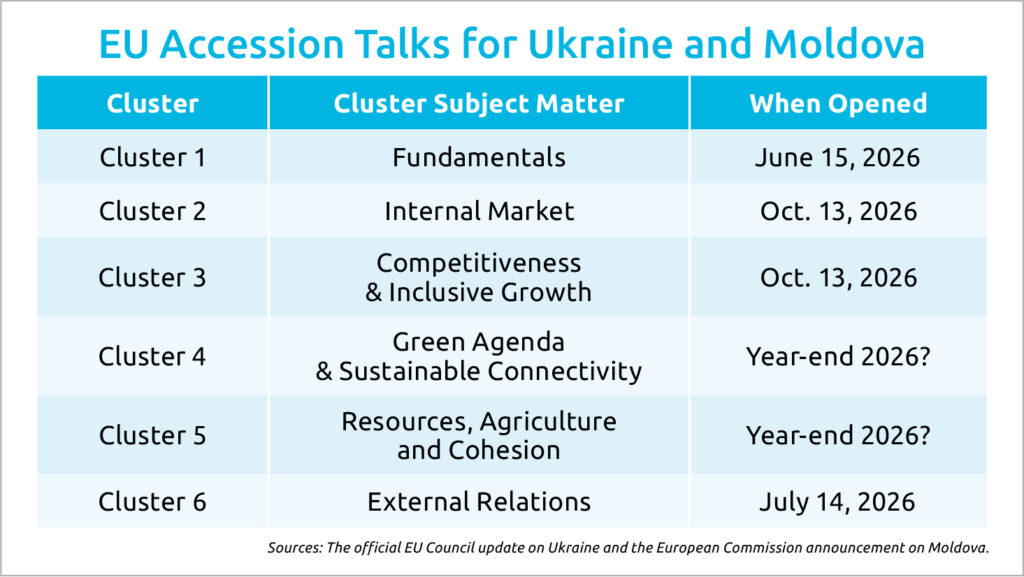
Accordingly, Hungary dropped its objection at the Council of the EU’s Working Party on Enlargement (COELA) on Oct. 7, allowing approval of the screening results for cluster two, covering the internal market, and cluster three, covering competitiveness and inclusive growth. EU ambassadors agreed the same day to invite Kyiv and Chisinau to submit their negotiating positions, the procedural step Budapest had held up since July.
The Fidesz parliamentary group had argued in an Oct. 3 statement to state news agency MTI that Kyiv had no intention of securing the rights of Transcarpathian Hungarians and sought only to speed the flow of EU funds to Ukraine.
“Since Hungary has still received no guarantee that the bill will be adopted and enforced, Ukraine continues to trample the rights of the Hungarian minority despite the victory reports,” the group said.
Arriving at the Foreign Affairs Council in Luxembourg on Oct. 12, Anita Orbán told Hungarian reporters that Hungary would monitor implementation through the education subgroup of the bilateral intergovernmental economic joint commission, together with Transcarpathian minority organizations. “We are waiting for the news from Kyiv,” she said.
The Rada passed the law that afternoon with 266 votes in the 450-seat chamber. It allows schools where more than half of pupils study in an official EU language or a language of Ukraine’s recognized Indigenous peoples to receive special status, a provision that excludes Russian, and requires their head or deputy head to be proficient in that language. Such schools may introduce Ukrainian-language lessons only with the backing of two-thirds of parents.
Hours later, President Volodymyr Zelenskyy signed the law, which entered into force on Oct. 13. László Zubánics, president of the Hungarian Democratic Association of Ukraine (UMDSZ), told Telex that only eight of the roughly 100 schools attended by Hungarian pupils fall below the majority threshold, and that a school granted the status keeps it until the minority share drops below 20%.
“We welcome today’s important step by the Ukrainian Parliament on minority education rights. A positive result of months of joint work and constructive dialogue,” Anita Orbán wrote on X before meeting Ukrainian Foreign Minister Andrii Sybiha on the sidelines of the council. For his part, Sybiha thanked Budapest for its constructive position.
“I will never tire of repeating: there is no better way to guarantee the rights and security of the Hungarian national minority in Ukraine than to ensure Ukraine’s accession to the EU as soon as possible,” he said.
Magyar told parliament after the vote that Kyiv had met its commitment ahead of the year-end deadline set in June, with parts of the law taking effect immediately and others in stages.
“Much remains to be done for trust to be restored on both sides, but the leadership of both countries has taken the first steps to settle the situation, not exclusively but primarily in the interest of our Transcarpathian Hungarian brethren,” he said.
Ukraine opened clusters two and three at its fourth accession conference in Luxembourg on Oct. 13, bringing the number of open clusters to four of six. Clusters four and five, covering the green agenda and sustainable connectivity, and resources, agriculture and cohesion, respectively, remain closed, with the European Commission and the Irish presidency aiming to open them by the end of the year.
This article was first published in the Budapest Business Journal print issue of October 19, 2026.