


DUIHK has been conducting these regular business surveys every year since 1994 and made them biannual in 2017, providing a long-term perspective on trends in the Hungarian economy. In fall 2025, more than 240 participants, German and Hungarian businesses as well as other foreign companies in Hungary, shared views on their own business expectations and on key risks to their operations.
A unique feature of the study is the “AHK World Business Outlook,” a simultaneous survey of the global network of German chambers, which enables comparisons of Hungary’s business climate with those of other economies worldwide.
Presenting the latest results, the DUIHK’s vice chairman, Achim Weinstock, stressed that there was no indication of a rapid or noticeable upswing in business performance.
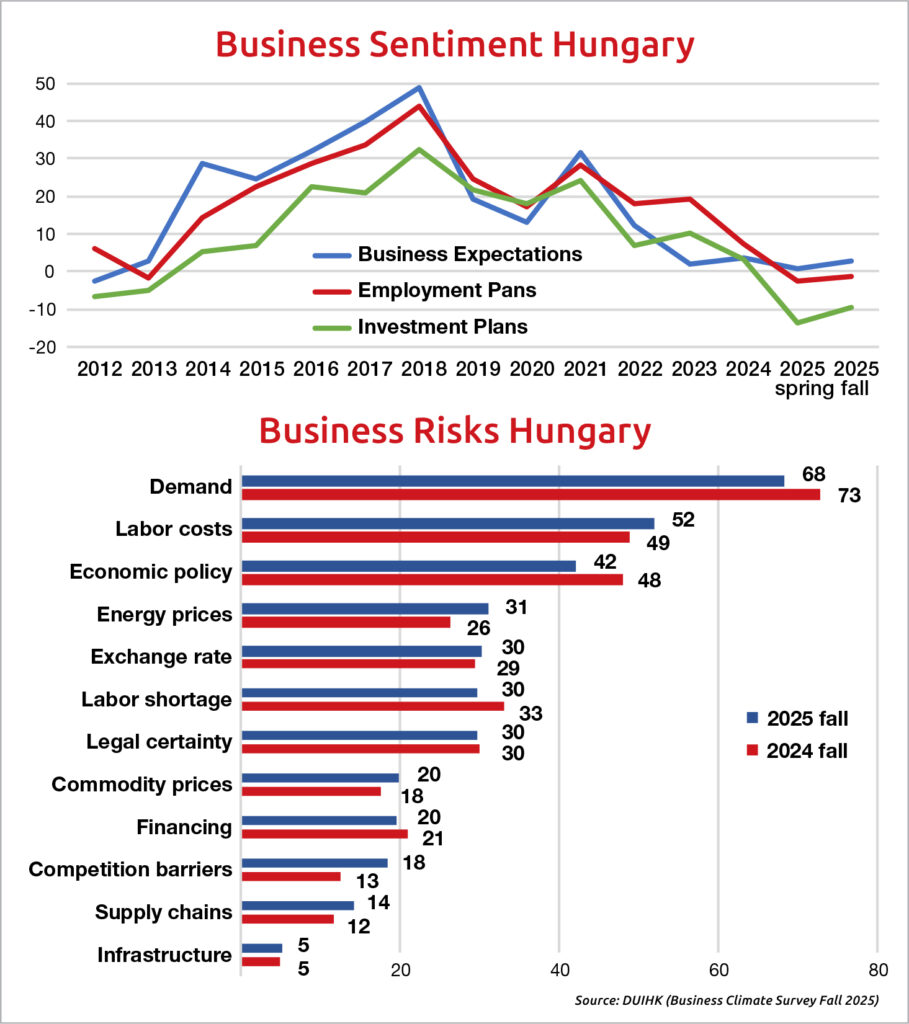
“The balance of positive and negative responses remains close to zero, signaling a stabilization of the economy at a quite low level rather than a meaningful recovery,” he noted
Indeed, both the assessment of the current situation and the 12-month expectations stayed at or just exceeded the results of previous surveys since the beginning of 2024. The chamber attributed this primarily to weak demand in export markets and domestically.
That lack of demand also weighs on employment and investment plans. While one in five companies still plans to hire additional workers next year, almost as many will probably reduce staff, particularly among larger, export-oriented manufacturers. Investment intentions are similarly subdued: only 24% foresee an increase, while 34% plan to cut back capital expenditures.
These figures place Hungary in the lower mid-range compared to the business sentiment in other Central and Eastern European countries, Weinstock said. He referred to the “AHK World Business Outlook,” conducted and published simultaneously with the survey in Hungary.
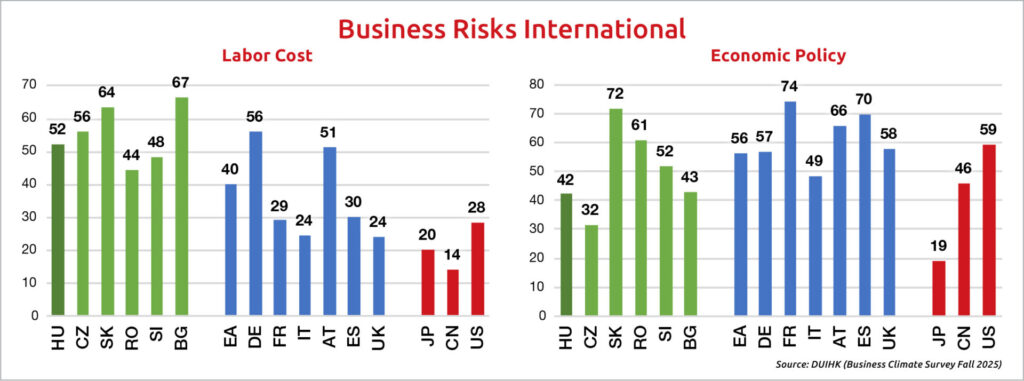
According to the latest WBO, companies in markets such as the Czech Republic, Romania and Bulgaria reported more optimistic business expectations and stronger employment plans, while others, such as Slovakia and Slovenia, face similar problems to Hungary.
The diverging trends in regional economies partly refute the frequently heard assertion that only the weakness of the German economy is responsible for Hungary’s disappointing economic situation, Dirk Wölfer, the author of the local study, said. The Czech Republic is even more dependent on the German market than Hungary, but still shows a much better economic performance.
A highly revealing comparison of economic conditions across countries can be drawn from the answers to the question of the most critical business risks. In Hungary, 68% of companies named lack of demand as an important risk, but labor costs were ranked second, at 52%.
Companies are not so much concerned about the nominal level of labor costs in Hungary, still among the lowest in Europe, but rather about their surge in recent years, Wölfer explained. In the last five years alone, labor costs in Hungary have risen by 71%. In the Czech market, the pace was only 25%, and in Germany, just 20%. Among the 61 countries surveyed worldwide, Hungary’s labor cost risk was the fifth-highest.
According to the survey, companies expect an average wage-cost increase of 6.2% in 2026, but the planned double-digit increase in minimum wages could further increase pressure.
More than a quarter of companies plan to offset rising wage costs through rationalization measures, such as automation or digitalization. Among industrial companies, nearly 40% will apply such measures, underscoring competitive pressure in internationally exposed sectors.
The third most important risk in Hungary was the economic policy framework, with 42% seeing it as a threat to their business. Hungary is not alone in this: in 48 of the 61 countries surveyed, economic policy ranked among the top three risks, in many cases even ahead of weak demand.
In contrast, legal uncertainty seems to be a much more prominent issue in Hungary than in many other countries. Here, it was named a risk by almost one in three companies, compared with only 19% worldwide. In CEE, only two countries reported a figure as high as Hungary.
Providing the broader economic narrative, Ákos Kozák from the Equilibrium Institute placed Hungary’s outlook within the wider European context and offered a long-term view of the characteristics of the Hungarian economy.
He warned that Hungary’s GDP growth in 2025 may fall short even of 1%. Kozák sees the medium-term growth prospects limited by low labor productivity and the narrowing workforce pool. Nonetheless, some positive impetus may come from EU-funded investment sources, gradually recovering consumer confidence and ongoing industrial developments, particularly in automotive and battery manufacturing.
But even then, risks remain regarding global trade tensions, fluctuating energy prices and demographic constraints.
The complete analysis of the DUIHK’s Hungary survey, the global “AHK World Business Outlook” and Kozák’s presentation can be found on the German chamber’s website.
This article was first published in the Budapest Business Journal print issue of November 28, 2025.


