


BBJ: What were the final FDI figures for 2024?
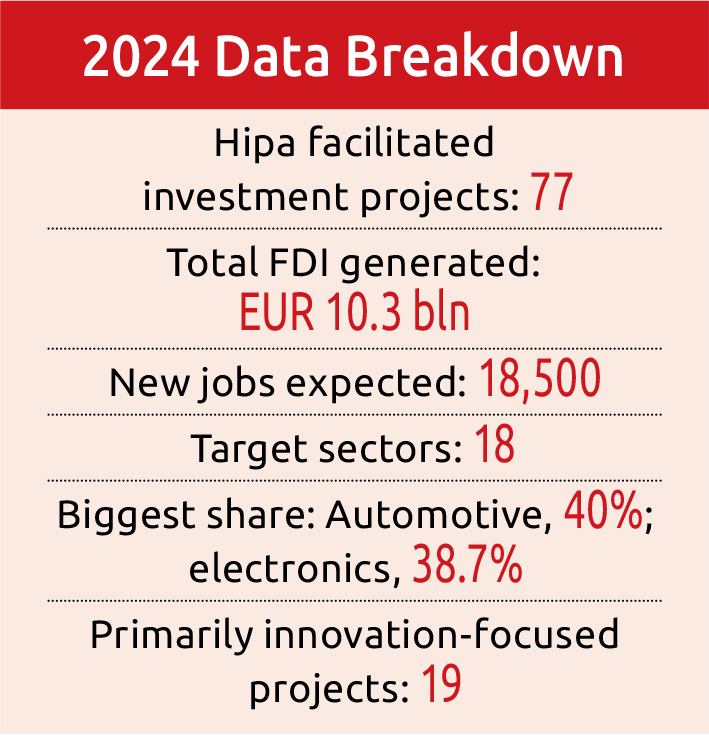
István Joó: Hipa achieved outstanding results in 2024, with investment capital inflow exceeding the EUR 10 billion mark for the second year running. Our results clearly demonstrate that investment promotion is the first key area where economic neutrality and connectivity are proven successful. Hipa facilitated deals on 77 investment projects, which will inject EUR 10.3 bln of fresh capital into the economy and are expected to create 18,500 jobs.
BBJ: How does 2024 compare with previous years?
IJ: 2024 is the second most successful year in Hipa’s history, trailing only the record-breaking year of 2023, even though Europe experienced a 45% decrease in FDI. Our results reflect a balanced structure, with contributions from both East and West and a record number of Hungarian projects. Another highlight is the prominence of the highest value-added activities.
BBJ: How are these Hipa-guided projects distributed across the country?
IJ: Eighty-two percent of new investments target areas outside the capital, highlighting that Hungary awaits investors with high service standards across the country. The tier-two university towns, such as Debrecen and Szeged, show a constant growth pattern and are emerging as alternatives to Budapest.
BBJ: How do the various projects break down in terms of industry sector?
IJ: The investments are spread widely across the economy, targeting 18 sectors. Automotive accounts for nearly 40% of the investment volume, closely followed by electronics, with a 38.7% share of the total investments.
Investors increasingly rely on Hungary in innovation and development, as reflected in the strengthening of the BSCs. The sector already contributes 3% to the country’s GDP: the number of positions in R&D has doubled in a single year, and total employment exceeds 110,000. Together with ICT and other R&D activities, 19 projects stand out as primarily innovation-focused investments. These projects will help ensure that Hungary leads in the number of patents registered in the battery industry across Europe.
BBJ: Which are the top contributors in terms of origin country?
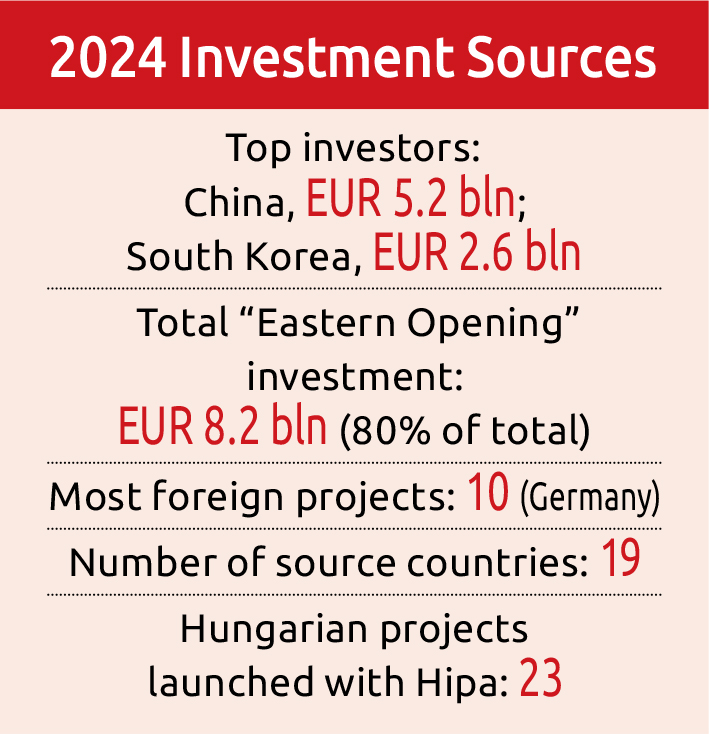
IJ: Investment promotion is about combining multiple sources of growth and finding the right balance. This is especially important when Western economies perform poorly. This is why China takes the lead with EUR 5.2 bln, South Korea is second with EUR 2.6 bln, and the countries involved in the Eastern Opening policy overall account for EUR 8.2 bln, or 80% of the total investment volume. At the same time, the largest number of foreign projects, at 10 investments, came from Germany, the country that has been Hungary’s number-one partner for many decades.
Hungary aims to become a meeting point for Eastern and Western capital and technology. This is reflected in the diversity of 2024: our country attracted investors from 19 foreign countries across three continents. At the same time, Hungarian-owned companies launched 23 projects in cooperation with our agency, reaching a new high.
BBJ: How do you expect the figures to change in 2025?
IJ: After creating new industrial ecosystems in the Miskolc–Nyíregyháza–Debrecen triangle, we need to strengthen the southern regions. In this regard, BYD’s decision to build its first European car factory in Szeged is a significant milestone. It is also our mission to support R&D projects and Hungarian companies further. 2025 will be crucial for several large-scale projects. We expect BYD’s factory and BMW’s iFactory in Debrecen to commence production. In addition, operations such as CATL, Lego and Nestlé will either start or expand their capacities.
BBJ: In terms of the Hipa toolbox, are there any new incentives or tax breaks you can offer in 2025?
IJ: Hipa continually refines its investment promotion schemes, but the core principles remain unchanged. Hungary’s competitive tax system, alongside our tailor-made financial incentive offers, will remain central to our strategy. One of our key new initiatives is a series of forums where investors meet local suppliers. A prime example is BYD’s first Hungarian Suppliers’ Forum, which proved a great success.
BBJ: As an agency, Hipa again won significant recognition in 2024; are there any you are particularly proud of?
IJ: Receiving recognition is always an inspiration. In this regard, 2024 was no exception, as our efforts were recognized by Site Selection Magazine, which publishes the Global Best to Invest ranking. For the second consecutive year, Hungary ranked first in Eastern Europe & Central Asia.
BBJ: The German economy on which Hungary relies continues to struggle, and tensions between the U.S. and the EU, the EU and China, and China and the U.S. all seem likely to grow. Does this economic environment concern you?
IJ: Hungary is indeed facing a challenging external environment; this is also why we have a constant obligation to support firms and save jobs. That is precisely the main driving force behind our latest endeavor, the “100 New Factories Program.” Germany’s GDP has been decreasing since 2023, and Europe’s largest economy is expected to remain in recession this year. This is concerning for Hungary, given the close integration of our economies.
Despite the crisis in Germany, German investors launched 28 projects in 2023-2024, securing the top position in the investor country ranking in both years. We hope the new German government will once again prioritize the growth of the German economy and businesses. Many German companies have faced severe losses due to radical economic ideologies.
It is also encouraging to see that, today, we have the best relationship with the new American administration in all of Europe, and we also have the best relationship with China. This is an exceptionally good opportunity for Hungary to enter a golden era.
This article was first published in the Budapest Business Journal print issue of March 7, 2025.


